

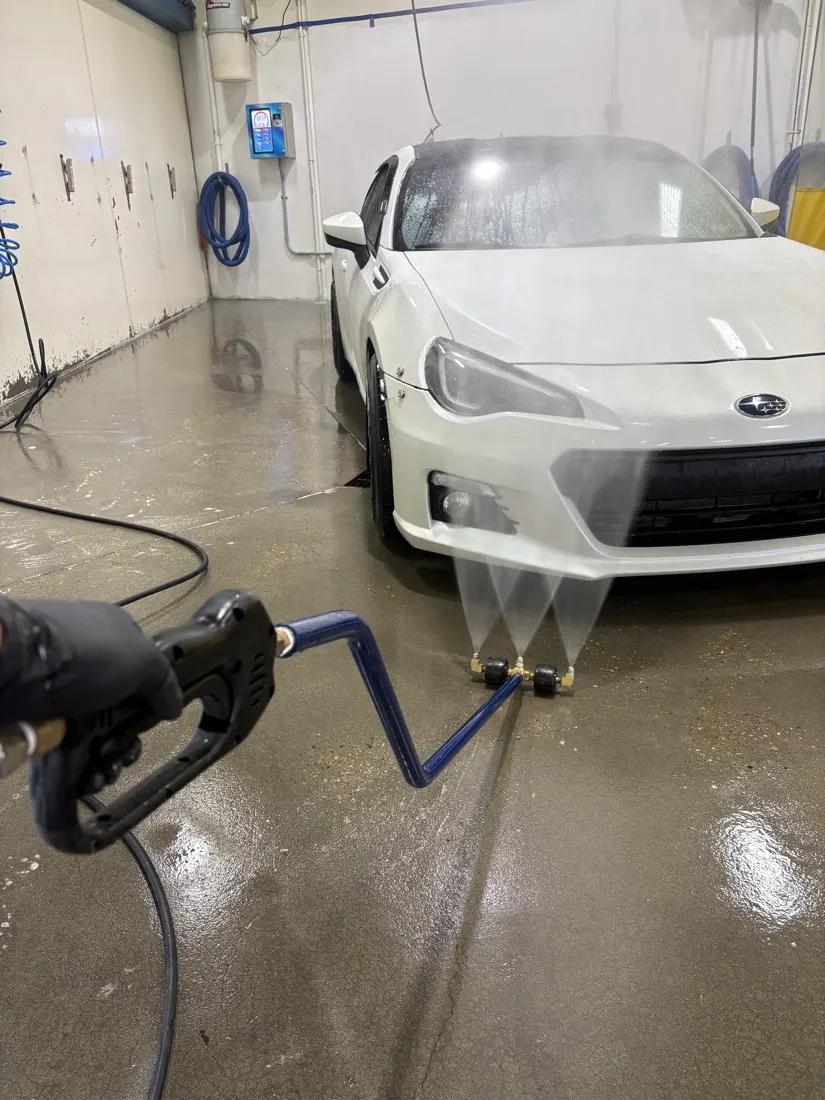
How often should you wash your car in an Alberta winter?
Every 10 to 14 days while there’s salt on the roads, and weekly if you can, especially for a newer or high-end vehicle. Go sooner after a snowfall or when a mild spell turns everything to slush, and always wash the underside, because that’s where the salt sits longest and does the most damage.
The short answer
- Every 10 to 14 days from the first salted road in the fall until the spring melt washes the streets.
- Weekly if you can, especially for a newer or high-end vehicle, one you plan to keep for years, or one that does a lot of highway driving. Washing every week won’t hurt it, and the salt never gets a chance to settle in.
- Sooner after a snowfall once the roads have been cleared, when a mild spell turns the roads to slush, and after a long winter drive on Highway 2 behind trucks.
- Sooner again if you park in a heated garage. Slush that melts off the car overnight keeps the salt on it wet.
- Every time: the undercarriage, the wheel wells and the rocker panels.
Ten to fourteen days isn’t just our number. Reader’s Digest Canada (opens in a new tab) calls “about every 10 to 14 days” a good rule of thumb wherever the roads are salted, which it says is “basically, all of Canada,” and every week when the roads look white with salt. In Calgary, Metro Ford (opens in a new tab) recommends every 10 to 15 days in winter. Consumer Reports (opens in a new tab) sets the floor lower, at a monthly wash during snow season, “or more often if the vehicle is coated in salt.” Weekly is better if you can manage it: the less time salt sits on the car, the less it can do.
Every 10 to 14 days the minimum while there’s salt on the roads
Weekly better for a newer or high-end vehicle, or a lot of highway
What’s on Alberta roads, and why the underside matters
According to 511 Alberta (opens in a new tab), the province’s highway crews choose what to spread by the temperature. Salt melts ice, but below −10°C it “is not very effective,” so crews lean on sand for traction. In some colder parts of the province they also use calcium chloride and magnesium chloride as de-icers. In practice most of a winter’s driving is on some mix of all four, and your tires throw it upward.
Up is where it hurts. Salt dissolved in water is what makes steel rust faster, and the wettest, least-rinsed places on a car are the ones you can’t see: the frame, the brake and fuel lines, the inside of the wheel wells and the bottoms of the doors and rockers. In summer, rain rinses those spots for free. From November to March, nothing does unless you wash them.
- The wheel wells
- The frame, and the brake and fuel lines underneath
- The rocker panels and the bottoms of the doors
That’s why a wash that only does the paint isn’t a winter wash. The paint is the part you notice. The underside is the part that rusts.
Every winter problem in this post, solved at 5105 40 Ave
Top Gear Car Wash has eight self-serve bays, two RV and truck bays and a touchless automatic, all indoors and heated. Open 7am to 8pm every day.
Undercarriage spray in every bay
Salt sits underneath. Every self-serve bay has an undercarriage washer, and every touchless package sprays the undercarriage and rockers at high pressure. The $20 Top Gear package does it twice.
Heated indoor bays
Too cold to wash outside? Every bay is indoors in a heated building, with hot water, so the temperature outside doesn’t decide when you wash.
Dryers and blowers
Water left in the door seals is what freezes them shut. Every self-serve bay has a dryer, and every touchless package ends with a drying agent and a blower.
Hot water from a wand
Ice packed in the wheel wells melts out when you aim hot water straight at it, in a self-serve bay from a $2.00 minimum.
Pull-through RV and truck bays
Too big for a regular bay? Two pull-through RV and truck bays with 15 ft by 12 ft doors take trucks, trailers and RVs, from a $5.00 minimum.
A touchless automatic
Rather stay in a warm car? Three packages at $12, $16 or $20, and nothing touches the paint.
When to go
After the snow stops, not during it
Wait until the snowfall is over and the roads have been cleared and treated. Washing in the middle of a storm only gets the car dirty again on the way home.
When the roads turn to slush
Slush is salt water, and your tires throw it everywhere. When a mild spell turns the roads to slush, the salt on your car is soaked and working again, so that’s a good day to wash. A cold snap is no reason to wait, though: in a heated indoor bay, a −25°C day is fine for a wash too.
Earlier in the day
If you can, wash in the morning or early afternoon, so the car has the rest of the day to finish drying before the overnight low.
How cold is too cold to wash your car?
In a heated indoor bay, it isn’t. The car is washed, rinsed and dried in the warm, so a −25°C day is as good a day to wash as any. The cold doesn’t hurt the car. What causes trouble is water left behind when you drive back out: in the door seals, the locks and the fuel door.
In a heated indoor bay
In an open-air or unheated bay
Outdoors is where the cold matters. In an open-air or unheated bay, once it’s well below zero the wand freezes, the floor freezes, and so does the car before you can dry it.
Wherever you wash, the few minutes after it are what need care on a cold day. See keeping the doors from freezing below.
Wand wash or touchless in winter?
Either is fine, as long as it does the underside. The choice is mostly about how much salt there is and whether you want to get out of the car.
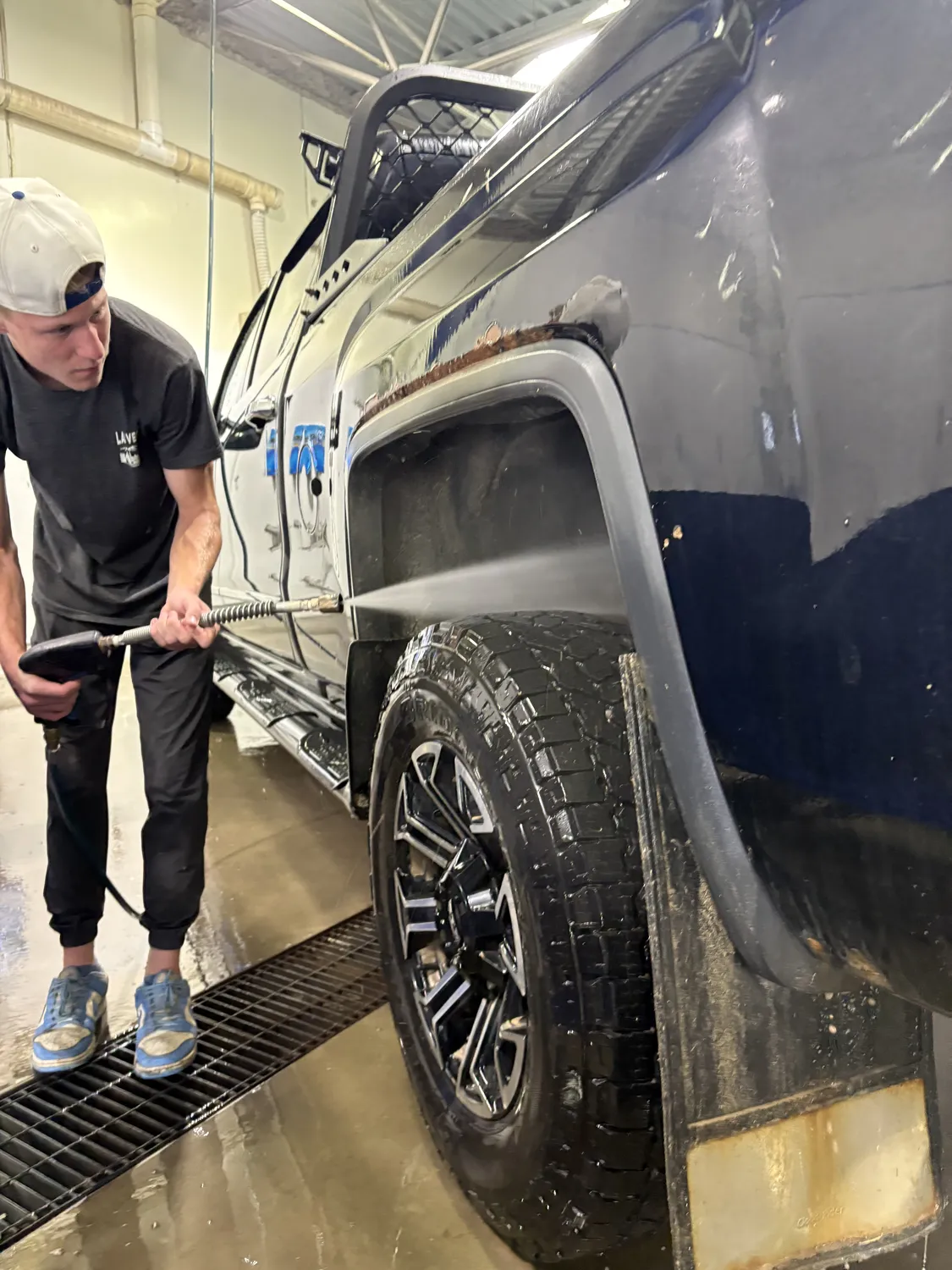
A self-serve wand bay
Best when the wheel wells are packed with slush and sand, or for a truck that’s been on gravel roads. You aim the water exactly where the salt is, and hot water melts the ice out of the wheel wells. Use the undercarriage washer on the frame and the rockers, and finish with the spot-free rinse and the dryer.
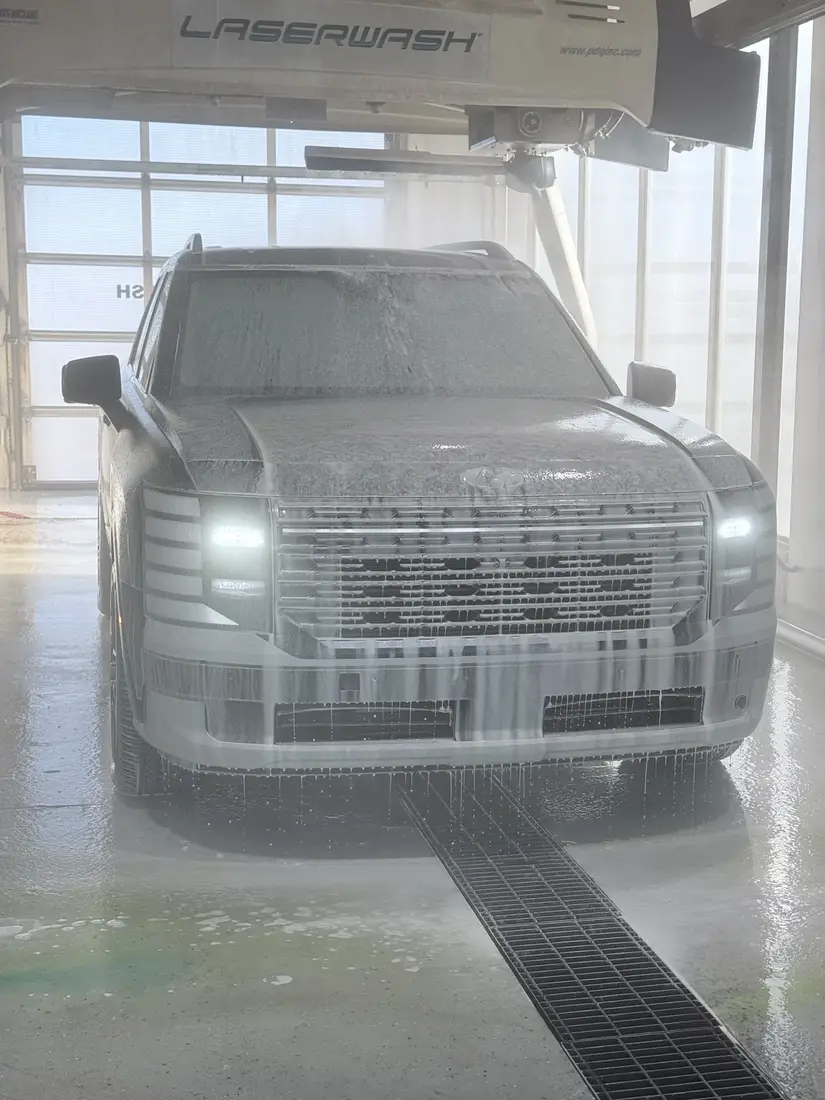
A touchless automatic
Best for a regular every-two-weeks wash. You stay in a warm car, and a good touchless wash runs a high-pressure spray along the underside and the rockers as well as the paint. A drying agent and a blower at the end mean less water left to freeze.
Keeping the doors and locks from freezing after a wash
Water that gets into the rubber seals around the doors freezes as soon as you’re back outside, and in an Alberta January that can mean a door that won’t open the next morning. A minute in the bay prevents it:
- The rubber seals and door jambs, all the way round each door
- The fuel door
- Let the dryer or blower finish. In a wand bay, use the spot-free rinse and then the dryer.
- Before you pull out, open each door, the trunk and the fuel door, and wipe the rubber seals and the door jambs with a dry towel. Keep an old towel in the car for it all winter.
- Tap the brakes gently a few times once you’re on the road, to dry them off.
- Once in the fall, wipe the door seals with a silicone spray made for rubber. It keeps them from sticking to the frame when they do get wet.
If a door does freeze shut, push firmly on it to crack the ice before you pull the handle. Yanking the handle is how they break.
Winter car wash questions
Is it bad to wash your car in winter?
No. Leaving road salt on the car is worse than washing it off. The only real risk is water freezing in the door seals and locks afterwards, and a heated bay, the dryer and a towel on the seals take care of that.
How cold is too cold to wash your car?
In a heated indoor bay, no temperature is too cold, because the car is washed and dried in the warm. Outdoors or in an unheated bay, below freezing is a gamble: the water can freeze on the car before you can dry it. On the coldest days, wipe the door seals dry before you drive off.
Is an undercarriage wash worth it in winter?
Yes. It is the most important part of a winter wash. Salt and sand collect on the frame, the brake lines, the rocker panels and in the wheel wells, where no rain will reach them until spring. You can skip it in summer.
Should I wash my car right after it snows?
Wait until the snow has stopped and the roads have been cleared, then wash. Washing in the middle of a storm only gets the car dirty again on the way home.
Does wax or a sealant help in winter?
It helps slush and salt rinse off instead of sticking, but it doesn’t replace washing. Consumer Reports found that wax fades after a few weeks, so a coat in the fall won’t last until spring. A protectant with each wash keeps it topped up.
Salt from the highway? We’re just off Highway 2 (the QEII) between Red Deer and Calgary, on the way to Edmonton, and Highway 2A runs right through town. Find us at 5105 40 Ave, Innisfail, a short drive from Penhold, Bowden and Pine Lake.
Sources
- 511 Alberta, About snowplows (opens in a new tab): how crews choose salt, sand and chlorides by temperature.
- Consumer Reports, How often should you wash road salt off your car? (opens in a new tab): washing frequency, underbody washes and how long wax lasts.
- Reader’s Digest Canada, How often should you wash your car in winter? (opens in a new tab): every 10 to 14 days on salted roads, weekly when they’re white.
- Metro Ford, How often should I visit a car wash in Calgary, Alberta? (opens in a new tab): every 10 to 15 days in a Calgary winter.
Published . More from the blog.